
Community
City of San Leandro and Bay Ecologists Deploy Living Shoreline Oyster Reef Domes at San Leandro Marina
Three hundred cast-concrete reef balls and native eelgrass beds along Mulford Point buffer winter storm waves while restoring San Francisco Bay marine habitat.
Your listening Queue & catch up
Add a story or build a catch-up queue to start listening.
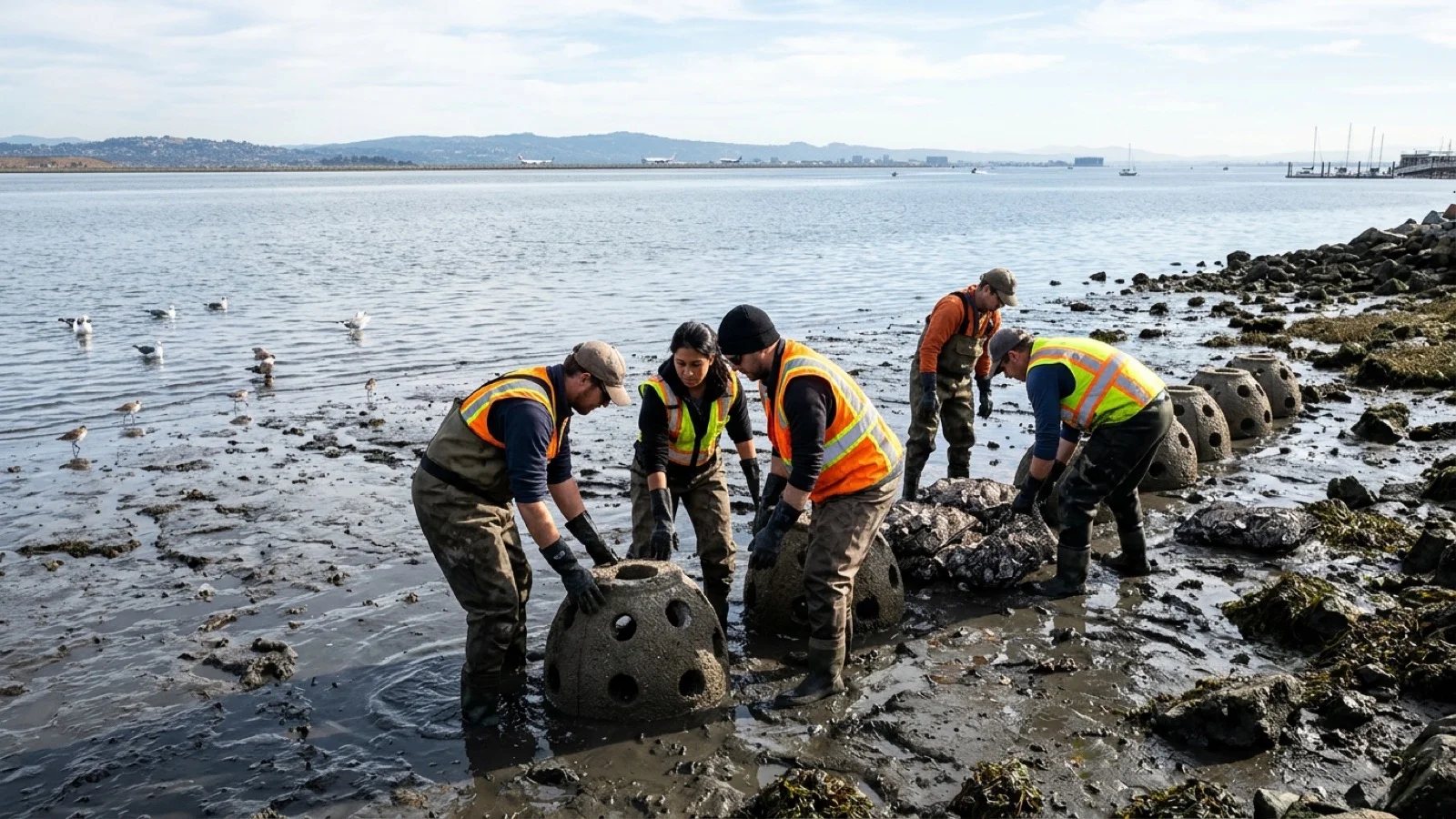
Marine biologists from the Coastal Conservation and Research Coalition and shoreline engineers with the City of San Leandro Public Works Department completed the low-tide placement of 300 perforated bio-concrete oyster reef domes on Friday morning along the intertidal mudflats bordering Monarch Bay Drive and Mulford Point at the San Leandro Marina. Designed as a nature-based "living shoreline" breakwater along the East Bay coast, the three-foot-wide domes are cast from a low-pH marine concrete mixed with recycled Pacific oyster shells that naturally attract free-swimming native Olympia oyster larvae (Ostrea lurida). Arranged in three staggered crescent rows 150 feet offshore from the San Leandro Bay Trail dike, the reef array trips incoming wind waves during winter southerly gales.
Wave-flume modeling conducted with UC Berkeley coastal engineers demonstrated that once encrusted with native oysters, bay mussels, and rockweed, the submerged reef balls attenuate up to 45 percent of nearshore wave height during storm tides, significantly slowing erosion along the earthen Bay Trail levee and adjacent Monarch Bay golf course shoreline. Behind the protective reef shadow, divers also transplanted 1,800 shoots of native Pacific eelgrass (Zostera marina) harvested from healthy donor beds off Point Molate.
Over the next twelve months, a single acre of established oyster reef and eelgrass meadow is capable of filtering millions of gallons of bay water daily while providing critical spawning substrate for Pacific herring, Dungeness crab juveniles, and bat rays. Undergraduate marine biology interns from California State University, East Bay in Hayward will conduct quarterly low-tide quadrat counts to measure oyster spat recruitment and sediment accretion behind the domes.
The $780,000 living shoreline installation was funded through a San Francisco Bay Restoration Authority Measure AA grant matched with City of San Leandro Shoreline Enterprise funds. Residents and Bay Trail cyclists can view interpretive signage at the Mulford Point overlook or check volunteer shoreline monitoring dates on the San Francisco Bay Restoration Authority Portal.
Sources
Comments (0)
No comments yet. Be the first to share a thought on this story.