
Community
SF Bay Ferry Positions High-Capacity Battery Charging Float at Alameda Main Street Terminal
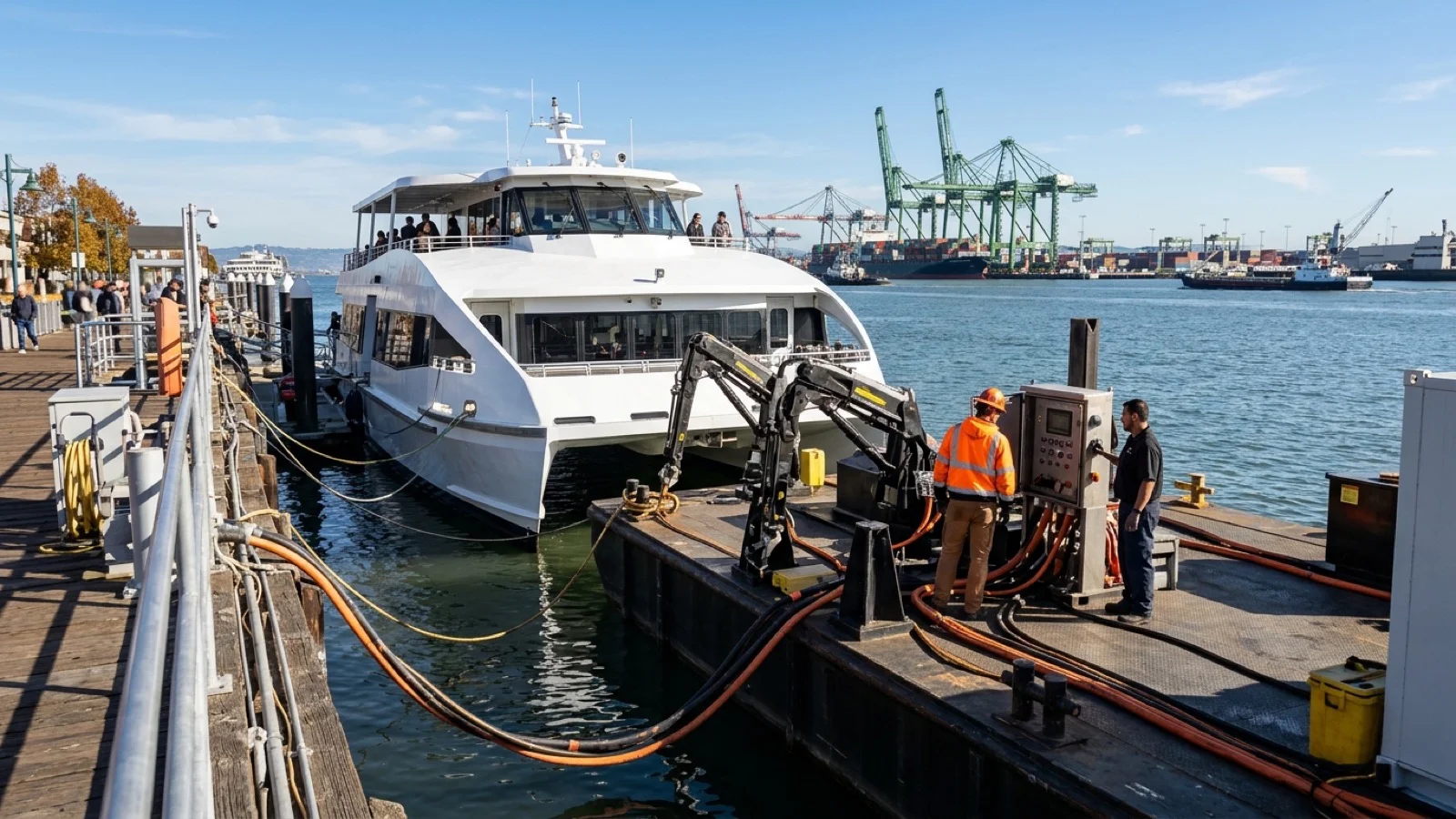
The 3-megawatt floating energy storage barge prepares the Oakland-Alameda estuary terminal for rapid turnaround charging of zero-emission commuter catamarans.
Your listening Queue & catch up
Add a story or build a catch-up queue to start listening.
Marine engineers with the San Francisco Bay Area Water Emergency Transportation Authority (WETA), operating as SF Bay Ferry, moored and energized a 110-foot floating battery-charging barge on Friday morning at the Alameda Main Street Ferry Terminal at 2990 Main Street along the Oakland-Alameda Estuary. Designed under WETA's Rapid Electric Emission-Free (REEF) maritime program in coordination with the City of Alameda, the steel utility float houses 3.2 megawatt-hours of marine-certified lithium-iron-phosphate battery racks below deck. By trickle-charging from the municipal grid of Alameda Municipal Power’s 100 percent clean electricity network throughout the day and night, the float can discharge up to 3 megawatts of DC fast-charging power into docked battery-electric ferries without requiring expensive shore-side substation rebuilds.
During a seven-minute passenger boarding turnaround at the Main Street pier, an articulated dockside robotic pantograph arm connects automatically to the vessel's superstructure, delivering enough clean electricity for a complete high-speed crossing between Alameda, Oakland Jack London Square, and the San Francisco Ferry Building. The Main Street installation will also serve the upcoming zero-emission Oakland-Alameda Estuary water shuttle vessel, giving cyclists and pedestrians a frequent link across the channel alongside existing Woodstock service.
By eliminating roughly 480,000 gallons of marine diesel fuel annually across the inner estuary routes, the electric ferry charging network is projected to cut waterfront greenhouse gas emissions by 4,900 metric tons per year while removing diesel exhaust plumes from West Alameda and Jack London Square neighborhoods. Acoustic hydrophone testing confirmed that electric waterjet propulsion reduces underwater hull noise by more than 12 decibels during estuary docking maneuvers.
The $15.6 million Main Street terminal electrification project was funded through a California State Transportation Agency Transit and Intercity Rail Capital Program grant matched with Regional Measure 3 bridge toll revenues. Commuters can view electric vessel deployment timelines and weekday ferry timetables on the SF Bay Ferry REEF Program Portal.
Sources
Comments (0)
No comments yet. Be the first to share a thought on this story.