
Local news
From Dark Factories to Zero-Page Websites
AI agents are learning to navigate an internet built for human eyes. Businesses may eventually give them a way around the pages.

Your listening Queue & catch up
Add a story or build a catch-up queue to start listening.
In China, machines can manufacture smartphones with the lights off. Xiaomi describes an automated assembly line operating in a “lights-out plant.” When production no longer requires people standing beside the machinery, lighting the workspace for human eyes becomes optional.
The popular name for this kind of operation is a dark factory. Its significance extends beyond electricity savings. Automation changes the environment in which work happens. Arrangements made for human workers become less important when machines take over their tasks.
Something similar may happen to the internet.
Today, technology companies are teaching AI agents to navigate websites: interpreting screens, finding buttons, filling forms and checking whether an action succeeded. These capabilities are impressive. But they raise a question: If a machine is doing the visiting, why must a business present itself through pages?
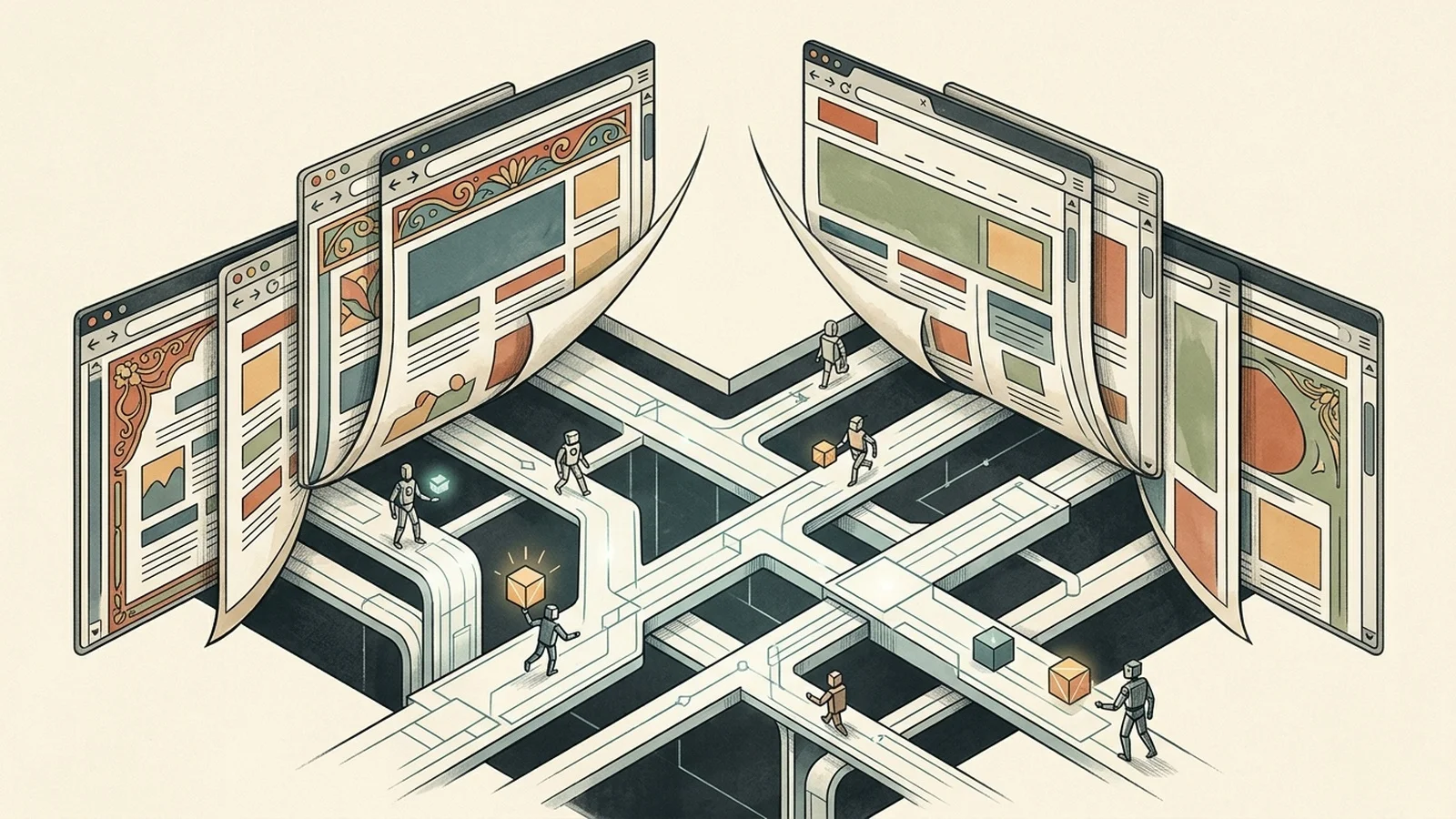
Call the alternative a zero-page website: an online service that an AI agent can discover, understand and use without navigating human-facing pages.
The business would still exist. So would its products, prices, policies and transactions. What becomes optional is the visual presentation built around a person operating the service.
The potential visitors are arriving. Meta’s Muse has a dedicated virtual computer and browser. Grok Bot offers agents a persistent cloud computer for work across applications and websites. OpenAI’s dots perform ongoing tasks using connected tools and their own computers. Perplexity’s Comet Assistant brings delegated work into the browser.
These products differ, and they can use direct integrations as well as visual interfaces. But together they point toward customers increasingly sending software to do their errands.
Browsers give agents access to the existing economy. A restaurant, retailer or repair service need not adopt new technology before an agent can attempt to use its website. That makes browser automation a practical bridge.
It also introduces a peculiar round trip. A business stores information as data and turns it into a page for people. An agent then interprets that page to recover the information and act on it.
Consider a restaurant reservation. A person might browse photographs, read the menu and explore the neighborhood. An agent instructed to book a table for four at seven needs available times, conditions, authorization and confirmation.
It could navigate a calendar and click through a form. A zero-page service could instead accept the request, return available choices and confirm the selected booking directly.
The restaurant would still need to manage capacity, prevent abuse and honor its commitments. It would no longer need to make the agent locate the right button.
This is the useful parallel with dark factories. Machines can first be introduced into an environment built for people. As their role grows, the environment can change around them. Just as a factory can be redesigned around robots, an online service can be redesigned around agents, without requiring them to follow the steps a person would take through a website.
Software developers will recognize familiar foundations. Application programming interfaces have connected computers for decades. Headless systems already separate business functions from their visual presentation.
Zero-page websites could build on those technologies. The ambition is to make a complete service usable beyond individually engineered integrations: an agent finds a business, understands its offering, establishes permission and completes a task.
That direction already has advocates. A June 2025 position paper argued for web interfaces designed specifically for agents. Nigel Dalton, Kate Linton and Karen Davis explored a similar manufacturing analogy in their August 2025 essay about a ‘lights-out web.’ WebMCP, a proposed web standard, offers an intermediate approach by letting existing pages expose explicit tools for agents.
The technology alone will not determine adoption. A retailer may welcome an automated purchase while resisting an agent that bypasses promotions and compares every competitor. Publishers need reporting to be funded even when assistants deliver information without sending readers to their sites.
Businesses will have to decide what agents may access and on what commercial terms. A customer’s instruction to an assistant does not automatically oblige another company to cooperate.
Nor does removing pages eliminate mistakes. An agent can misunderstand a request. A service can misrepresent its offering. Permission to check an appointment must not imply permission to cancel it, and a retried payment request must not become a second purchase.
Dark factories depend on carefully prepared processes, maintenance and oversight. Zero-page services would likewise require dependable operations and verifiable results. Removing the human interface raises the importance of getting those foundations right.
I expect a mixed internet. People will continue to browse shops, read publications and discover things they did not know to request. Businesses may retain those experiences while adding a direct entrance for agents. Some services may eventually find that the agent entrance is enough.
Customers would still review choices and outcomes, but increasingly through their assistants rather than a separate interface designed by every business.
For decades, companies have competed to attract visitors and guide them through pages. The next competition may concern whether software can reliably do business with them without visiting at all.
Dark factories show what happens when production no longer depends on a human presence. Zero-page websites suggest what could happen when online transactions no longer depend on human navigation.
We are teaching agents to use the web we have. Their greater effect may be on the web we build next.
Comments (0)
No comments yet. Be the first to share a thought on this story.
Nominate a neighbor or local businessRequest a correctionContact the newsroom